UNO Blender Rules
720 cards of pure UNO chaos
This is a project that I've been working on for a little while. It's a combination of seven different UNO variants, three other games, and the four UNO add-on packs. I actually started working on this before Massacre Mansion's Uno Amalgam (Chemicards), but my project combines actual UNO decks instead of creating custom cards.
What You Need
- UNO Party (Original Version) - 104+3 cards
- One in each color 0-9, and:
- One each of Yellow 4-6, 9
- One each of Red 1-2, 6, 9
- One each of Blue 1-4, 7, 9
- One each of Green 1-8
- Two each of Yellow 7-8, Red 7-8, Blue 8
- One in each color Skip, Reverse, Draw 2
- Two in each color Point Taken
- Two each of Wild, Wild Draw 4
- Four each of Wild Pile Up, Wild Drawn Together
- Two Link Cards
- One Direction Tracker
- UNO Show 'Em No Mercy - 88 cards
- One in each color 0-9
- One in each color Skip, Reverse, Draw 2
- Two in each color Skip Everyone, Draw 4
- Three in each color Discard Color
- Two each of Wild Reverse Draw 4, Wild Draw 6, Wild Draw 10, Wild Color Roulette
- UNO Flex - 84+8 cards
- Two in each color 1-8
- One in each color Skip//Skip Everyone, Reverse//Reverse Skip, Draw 2//Everyone Draw 1
- Two each of Wild All Flip, Wild//Wild Everyone Draw 2, Wild//Wild Targeted Draw 2, Wild Draw 4//Wild Targeted Draw 4
- Eight (or more) Power Cards
- UNO Remix - 80 cards
- One in each color 1-9
- One in each color Skip, Reverse, Draw 2, Stack 1
- Two in each color Skip Everyone, Gift, Shield
- Two each of Wild, Wild Draw 4
- UNO Minecraft - 60 cards
- One in each color 0-9
- One in each color Skip, Reverse, Draw 2
- Two each of Wild, Wild Draw 4
- Four each of Wild Creeper
- UNO Super Mario Bros. - 58 cards
- One in each color 0-9
- One in each color Skip, Reverse, Draw 2
- Two each of Wild, Wild Draw 4, Wild Super Star
- UNO Teams - 54 cards
- One in each color 1-9
- One in each color Skip, Reverse, Draw 2
- Two each of Wild, Wild Team Play, Wild Double Draw 2
- Phase 10 - 52 cards
- One in each color 1-12
- Two each of Wild, Wild Targeted Skip
- DOS (First Edition) - 48 cards
- One in each color 1, 3-10
- Two in each color #
- Four each of Wild DOS
- UNO Golf - 44 cards
- One in each color 0-6
- One in each color 10 Reverse, 11 Skip, 12 Draw 2, 22 Double Draw 2
- UNO Speed Pack - 16 cards
- One each of Yellow 1-3, Red 3-5, Blue 5-7, Green 7-9
- Four each of Wild Double Speed Up
- UNO Swap Pack - 12 cards
- One in each color Swap, Refresh Hand
- Two each of Wild Force Trade, Wild Pass Hands
- UNO Stack Pack - 12 cards
- One in each color Stack 1, Stack 2
- Two each of Wild Stack 3, Wild Stack Number
- UNO Reverse Pack - 8 cards
- One in each color Reverse Skip, Reverse Draw 2
Getting Started
Setup
You probably won't need to shuffle the deck unless this is your first game. Place the Direction Tracker and Link Cards in the center of the table and give each player a Power Card. Then, deal every player seven cards. Finally, flip over the top card of the deck to form the discard pile. If that card is an action card, then flip over more cards until there is a non-action card on top of the discard pile. Now the game can begin!
Basic Gameplay
Each player takes turns matching cards from their hand to the top card of the discard pile. Players are able to match by color, number, or any action symbol. Card modifiers are a separate property and cannot be matched to. For example, if the shown card is a Blue 8 with a Flip modifier, then the active player must play either a Blue card or an 8 card. Wild cards may be played on any card unless a play restriction would prevent a player from doing so.
If the active player has no matches or they choose not to play any of their cards even though they might have a match, they must draw from the deck (see Tempo). If a drawn card can be played, it may be played. Otherwise, the card is kept, and the next person in turn order becomes the active player.
Whenever a player's hand size changes to exactly one card, that player must call out "UNO!" If another player says "UNO" before them, then the player with one card immediately draws two cards as a penalty.
At the end of every turn, if a player has no cards in their hand, or if there is only one player remaining, then that player wins the game. On the other hand, if a player has 25 or more cards in their hand, they are eliminated. Eliminated players can no longer take any turns, and are considered out of the game. Eliminated players' hands are burned (placed at the bottom of the discard pile).
Tempo
During their turn, players must play a number of cards equal to the current tempo. The tempo starts at 1 and may increase from Speed Up effects. If a player is unable to play enough cards to meet the tempo, they play what they can and then draw cards equal to the tempo. If any of those cards are playable, they may be played, up to the number of cards still required to meet tempo. Then, the tempo resets back to 1.
Each card played must match the previous card. Action cards only take effect if they are the last card played on your turn (after drawing for not having a match).
Jump-Ins
During any player's turn, if you have a card that matches the shown card both in color and number/symbol, then you may play that card out of turn. Modifiers do not have to match. Wild cards are considered their own color for the purposes of jump-ins.
If a jump-in is successful, you immediately become the active player and can begin resolving card events. From this point, you can play more cards to meet tempo or draw cards from the deck as usual. However, if you play an illegal card out of turn, then you must take that card back and draw one card as a penalty. The active player does not change in this case.
Stacking
Whenever a Draw or Stack card is played, a penalty is added to the stack, and a play restriction comes into effect. If a player is unable to meet tempo while a stack is active, then they must draw cards equal to the stack's penalty, instead of drawing from the deck normally. (They may not play any more cards that turn. The tempo still resets.) If this happens, then the stack ends.
Flexing
Some cards have two sides: a "regular" side and a "flex" side. If your Power Card is green, you may play the flex side of a card by flipping your Power Card to red. Each side of a flex card has a different name and different effects. Only one side of a flex card can be played at a time (you must choose between the regular and flex side).
When you are matching to a flex card in the discard pile, always match to the primary color and symbol (the regular side). If every player's Power Card is red, then all players flip theirs back to green.
Additional Rules and Clarifications
Challenges
There are no challenges.
Modifiers
Flex side action symbols are not considered modifiers. There are five modifiers:
- Flip (Flex)
- Flip your Power Card, regardless of its current state.
- Trade (No Mercy)
- Trade hands with another player of your choice.
- Pass (No Mercy)
- All players pass their hand to the next player in the current turn order.
- Swap (Teams)
- Choose another player. You and that player both pass each other 1 card.
- Speed Up (Speed Pack)
- The tempo increases by 1.
Targeted Draw vs Reverse Draw
Targeted Draw and Draw are considered different symbols with different effects. Targeted Draw cards do not create or add to a stack when played. However, a Reverse Draw card has both the Reverse symbol and the Draw symbol, and may be played while there is a stack. Keep in mind that the Reverse symbol will activate before the Draw symbol.
Stacking and Jump-Ins
Players may jump-in even when there is a stack, however any card played must still respect the play restriction. If an illegal card is played, the active player does not change and the stack is unaffected.
Restrictions
Restrictions limit what cards are playable beyond just matching the current color or symbol. For example, a color restriction forces players to only play cards of a specific color. If at least one property of a card matches the restriction, then that card is eligible to be matched. In other words, played cards have to match the top card of the discard pile and the restriction.
Mini Tech
The secondary side of a flex card can be played on a mini-pile if its color matches the restriction. If a flex side is played, the next player must play a card matching the primary side while still following the mini-pile restriction. (Wild cards can also be played because they are also part of the mini-pile restriction.)
Event Order
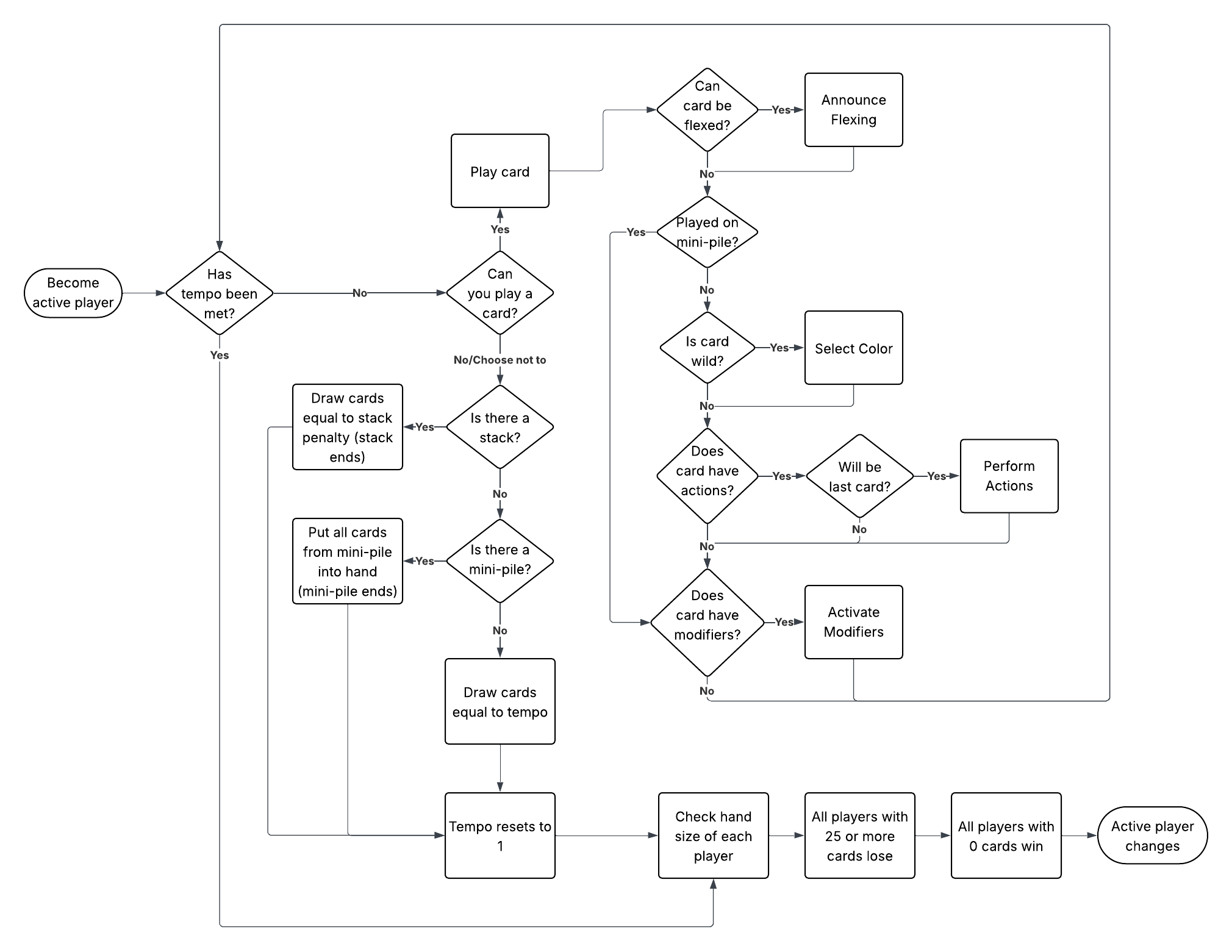
When a card is played, these events happen in the following order:
- Announce Flexing (if card can be flexed)
- Select Color (if card is Wild)
- Perform Actions (if card has action symbols)
- Activate Modifiers (if card has modifiers)
Skip the Perform Actions event if the card is not the last card played for tempo. If a card has multiple actions, perform them from left to right as they appear in the card's name. (For flex cards, the names of each side are divided by two slashes "//".) Once all events for the last played card are finished, the active player changes to the next player in the turn order.
A jump-in may not be performed while any of these events are unresolved.
Full Turn Overview
A flowchart has been provided for your convenience. (Click to view image at full resolution.)
List of Action Symbols
- Skip (Party, No Mercy, Flex, Remix, Minecraft, Mario, Teams, Golf)
- The player after next player in the turn order becomes the active player at the end of this turn.
- Targeted Skip (Phase 10)
- Choose another player. The next time that player would become the active player, instead the next player in the turn order becomes the active player.
- Skip Everyone (No Mercy, Flex, Remix)
- At the end of this turn, you become the active player.
- Team Play (Teams)
- Choose another player. That player becomes the active player. If that player is unable to meet the tempo, they draw cards equal to double the current tempo instead.
- Reverse (Party, No Mercy, Flex, Remix, Minecraft, Mario, Teams, Golf, Reverse Pack)
- The turn order is reversed. Flip the Direction Tracker to indicate the new direction.
- Draw 2/4/6/10 (Party, No Mercy, Flex, Remix, Minecraft, Mario, Teams, Golf, Reverse Pack)
- Add a penalty of 2/4/6/10 cards to the stack. If there isn't already a stack, create one. Play is now restricted to Draw, Stack, Shield, and Super Star cards until the stack ends.
- Stack 1/2/3 (Remix, Stack Pack)
- Add a penalty of 1/2/3 cards to the stack. If there isn't already a stack, create one. Play is now restricted to Stack, Shield, and Super Star cards until the stack ends. This card can be played on any Draw or Stack card of a matching color (you can't jump-in unless the symbol matches, though).
- Note: The Stack 3 symbol only appears on Wild cards, so it can be played on any card barring restrictions.
- Stack Number (Stack Pack)
- Reveal cards from the top of the deck until you reveal a number card. Add a penalty equal to the card's number to the stack. If there isn't already a stack, create one. All of the revealed cards are burned. Play is now restricted to Stack, Shield, and Super Star cards until the stack ends. This card can be played on any Draw or Stack card of a matching color (you can't jump-in unless the symbol matches, though).
- Note: The Stack Number symbol only appears on Wild cards, so it can be played on any card barring restrictions.
- Shield (Remix)
- End the current stack, if there is one.
- Super Star (Mario)
- The previous active player draws cards equal to the stack's penalty. Then, end the current stack.
- Targeted Draw 2/4 (Flex)
- Choose another player to immediately draw 2/4 cards.
- Double Draw 2 (Teams, Golf)
- Choose another player, twice. (You can choose the same player more than once.) The chosen player(s) immediately draws 2 cards for each time that they were chosen.
- Everyone Draw 1/2 (Flex)
- All other players immediately draw 1/2 cards.
- Drawn Together (Party)
- Choose two players and give each of them a Link Card. If two players are already linked, choose two new players. Anytime one of these players draws cards, the other player immediately draws the same number of cards. The Drawn Together link ends when a Point Taken card is played.
- Point Taken (Party)
- Put any Link Cards back in the center of the table. Then, count down "3, 2, 1!". On 1, every player points at one other player. Then, starting with you and continuing in turn order, each player draws 1 card for every player pointing at them, up to a maximum of 5 cards.
- Pile Up (Party)
- Reveal cards from the top of the deck until you reveal a colored card (any other revealed cards are burned). This card begins a second discard pile called a mini-pile, which all players must now play on. Play is now restricted to the color of the revealed card and Wild cards until the mini-pile ends.
- Any cards played on a mini-pile skip the Select Color and Perform Actions events. If a player is unable to meet tempo, then they must put all cards from the mini-pile into their hand instead of drawing from the deck. (They may not play any more cards that turn. The tempo still resets.) Play continues with the next player in the current turn order on the normal discard pile.
- Note: If the top card of the mini-pile is a different color than the restriction, normal matching rules still apply in addition to the restriction. See Mini Tech.
- Color Roulette (No Mercy)
- The next player reveals cards from the top deck until they reveal a card of the color you selected (Wild cards do not count). All revealed cards are added to that player's hand. The player after that player becomes the active player at the end of this turn.
- Discard Color (No Mercy)
- Refresh Hand (Swap Pack)
- Count the number of cards in your hand, then burn your hand and draw that many cards.
- Swap (Swap Pack)
- Choose another player. You and that player both pass each other 1 card.
- Force Trade (Swap Pack)
- Choose two players. Those players trade hands.
- Pass Hands (Swap Pack)
- All players pass their hand to the next player in the current turn order.
- Gift (Remix)
- When you draw this card from the deck, reveal it and pass it to another player.
- Creeper (Minecraft)
- Whenever a Creeper card enters your hand, you must immediately reveal it.
Then, draw a 3 card penalty unless:
- You have already received this penalty this turn
- You played the Creeper illegally as part of a jump-in
- The Creeper was in your opening hand
- DOS (DOS)
- This card counts as a 2 while it is the top card of the discard pile.
- # (DOS)
- Choose a number from 0-12, or 22. This card counts as that number while it is the top card of the discard pile. This card may be played on any number card if the number you choose matches that card.
- All Flip (Flex)
- All players flip their Power Card.
- Double Speed Up (Speed Pack)
- The tempo increases by 2.
-
Burn each card in your hand that matches the color of this card.
You don't need to call "UNO" if you have zero cards in your hand afterwards.